Yes, you can learn to code without a computer science degree, and plenty of working developers got there that way. Pick one language, follow a structured curriculum instead of random videos, build real projects you can show, and practise on a schedule you can actually keep. The degree helps in specific situations, but it is not the gate most people assume it is.
What makes the path work is evidence. A finished project with a README, a GitHub history, and the reasoning behind your technical choices tells a hiring manager more than a line on a resume. That is the whole game for anyone looking at how to learn to code without a computer science degree, and the rest of this guide breaks the process into the order that actually moves the needle.
Last updated for 2026.
Table of Contents
- 1Can You Learn to Code Without a Computer Science Degree?
- 2What a degree covers that is worth self-studying anyway
- 3What you can skip for now
- 4The honest obstacle is time, not theory
- 5Which Programming Language Should You Start With?
- 6How Do You Learn Programming Basics?
- 7Variables and data types
- 8Conditionals
- 9Loops
- 10Functions
- 11Data structures
- 12File handling and JSON
- 13Debugging and reading errors
- 14Git and version control
- 15The command line
- 16Reading documentation
- 17What Is the Best Way to Practice Coding?
- 18Small exercises, daily
- 19Type from memory, not by copying
- 20Use a challenge site for the boring reps
- 21Keep a project log
- 22Get feedback from somewhere
- 23A ten-hour week that works
- 24How Do You Build a Portfolio Without a Degree?
- 25Choose projects with real constraints
- 26Document the decisions, not just the code
- 27Publish it where recruiters look
- 28Contribute to open source once
- 29Write resume bullets that survive a filter
- 30Do You Need a Computer Science Degree to Get a Coding Job?
- 31How Long Does It Take to Learn Coding Without a Degree?
- 32What Should You Do First?
- 33Days 1-3: choose a language and set up
- 34Days 4-7: fundamentals and a log
- 35Week 2: data and files
- 36Week 3: version control and the command line
- 37Week 4: get one piece of feedback
- 38Frequently Asked Questions
- 39Can I become a software developer without a computer science degree?
- 40How long does it take to learn to code with no experience?
- 41Is 25 (or 35) too old to start coding?
- 42Do I need to know math to become a programmer?
- 43Is a coding bootcamp worth it compared with teaching yourself?
- 44Do AI coding assistants help beginners or ruin their fundamentals?
- 45Conclusion
Can You Learn to Code Without a Computer Science Degree?
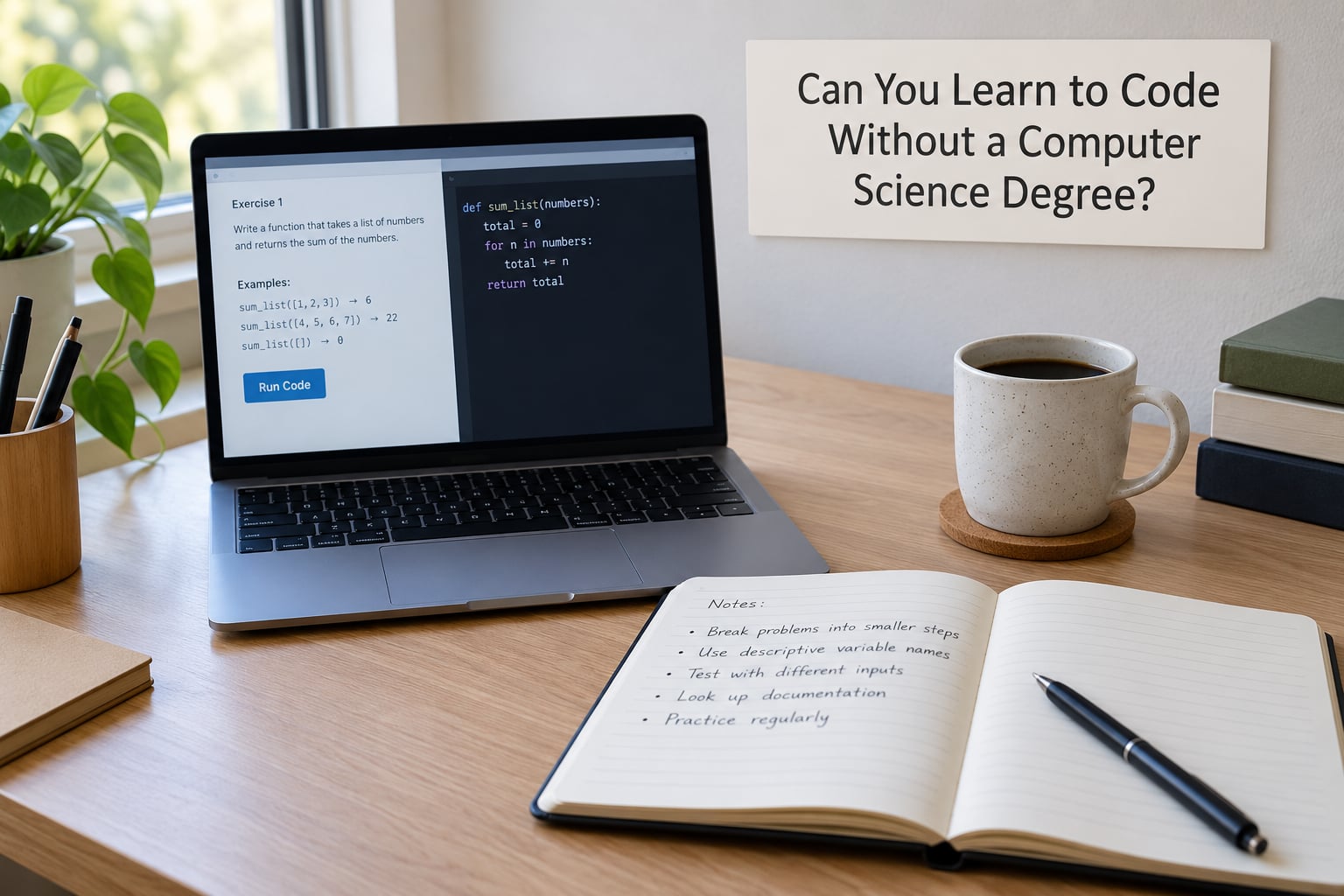
Yes. Hiring managers mostly cannot tell from a repository whether someone learned at university or taught themselves. What they can see is whether you can take a requirement, break it down, write working code, and explain your choices.
A computer science degree bundles three things together: a credential, a network, and a curriculum. The credential matters at a handful of large companies and in some regulated hiring pipelines. The curriculum is genuinely useful in parts. The network is real and quietly valuable.
What is not bundled is the part that actually decides whether you get hired: shipped projects, code review experience, debugging under pressure, and the ability to explain your work. Nobody hands you those at graduation, so a self-taught path has to build them deliberately.
What a degree covers that is worth self-studying anyway
Data structures and algorithms are the obvious one. Arrays, hash maps, linked lists, trees, sorting and searching are not academic decoration. They show up in interview questions and they decide whether your code is fast enough when the data gets large.
Computer networking basics matter too, mostly so error messages stop being mysterious. Knowing that a request travels through DNS, a socket, a server process and a database gives you a mental map for debugging. Basic operating system ideas about processes, memory and files round out the useful theory.
What you can skip for now
Compiler construction, formal automata theory, advanced type theory and proof-based algorithm analysis will not change your first year of work. Type theory is worth revisiting before roles in programming language design or heavily typed enterprise work, but it is a bad first month.
The honest obstacle is time, not theory
People who study on evenings and weekends while working full time describe the same problem: not ability, but competing obligations. One recurring account on the freeCodeCamp forum describes a part-qualified actuary finishing a front-end certificate in roughly three months of weekends and exam gaps, after first burning through standalone Codecademy modules and feeling like he was going nowhere. A curriculum with a defined order fixed what free-form courses had not. Sixty-hour work weeks nearly broke the plan.
Budget for that reality. Ten focused hours a week is a realistic baseline for someone with a full-time job, and it is enough to get to employability in a year rather than a decade.
Which Programming Language Should You Start With?
Pick one and stay with it for four to six months. Language-hopping is the single most common way beginners stall, because every switch resets your muscle memory while teaching you almost nothing new.
| Language | Learning curve | Where it is used | Best first projects |
|---|---|---|---|
| Python | Flattest of the three; almost no setup ceremony | Data work, automation, scripting, back-end services, AI tooling | Spreadsheet automation, file renaming scripts, a small API tool, a data report |
| JavaScript | Moderate; two ways to run it, which confuses beginners at first | Web front-end and back-end, browser extensions, serverless functions | A responsive web app, a browser extension, a full-stack app with a database |
| Java | Steeper; types and boilerplate arrive early | Large enterprise back ends, Android, data infrastructure | A console tool, a small REST API, a data pipeline job |
Choose Python if your goal is automation, data or back-end work. The syntax is close to English, and the standard library ships with enough to build real things without installing much.
Choose JavaScript if you want to build for the browser. Every front-end job needs it, and being able to open a page and change what appears on screen gives beginners a satisfying feedback loop early.
Java is the right pick only if the roles you are aiming at list it specifically. It appears often in enterprise and Android postings, and its type system teaches good habits, but it is a harder first language than the other two.
How Do You Learn Programming Basics?
Learn these concepts in this order. Each one builds on the last, and skipping ahead is why tutorials stop making sense around month three.
Variables and data types
How you store a number, a piece of text, a yes-or-no value, and a list of things. In Python you will not declare types, but you still need to know which type you have, because the operations available to you depend on it.
Conditionals
If this, do that, otherwise do something else. This is where your code starts making decisions instead of running straight through. Practise nesting conditions until the logic reads plainly, because unreadable nesting is the first thing reviewers complain about.
Loops
Repeat a block of work. A for loop walks through items, a while loop repeats until a condition flips. Loops are where a five-line script saves two hours of clicking.
Functions
Give a chunk of work a name, feed it inputs, get an output back. Functions are the boundary that makes code reusable and testable, and they are how you stop rewriting the same eight lines in three places.
Data structures
Lists, dictionaries, sets and tuples, then the idea of nesting them. This is the point where you start thinking about how to store and retrieve information, which is most of what programming actually is.
File handling and JSON
Reading and writing text files and structured JSON. Almost every real program touches the filesystem, and this is what turns a script into something useful at a job.
Debugging and reading errors
This deserves more time than beginners give it. Learn to read a stack trace from the bottom up, set breakpoints, and print things deliberately. The skill is not avoiding errors, it is working backwards from a message to a cause.
Git and version control
Init, add, commit, push, branch, merge. No computer science degree teaches this properly, because university courses hand you one repository and one project. In a job you will use branches daily, and knowing Git is often the single biggest gap between self-taught applicants and degree holders on day one.
The command line
Navigate folders, run programs, install dependencies, read logs. Expect a hundred hours across your first year. Windows users should learn PowerShell or WSL rather than assuming the Unix commands they read online will work as typed.
Reading documentation
The official docs for Python, JavaScript or Java are better than most tutorials once you know the basics. Learn to search a docs site, read a function signature, and test an example in your own project. Search-engine ability rots fastest if you never touch the source material.
What Is the Best Way to Practice Coding?
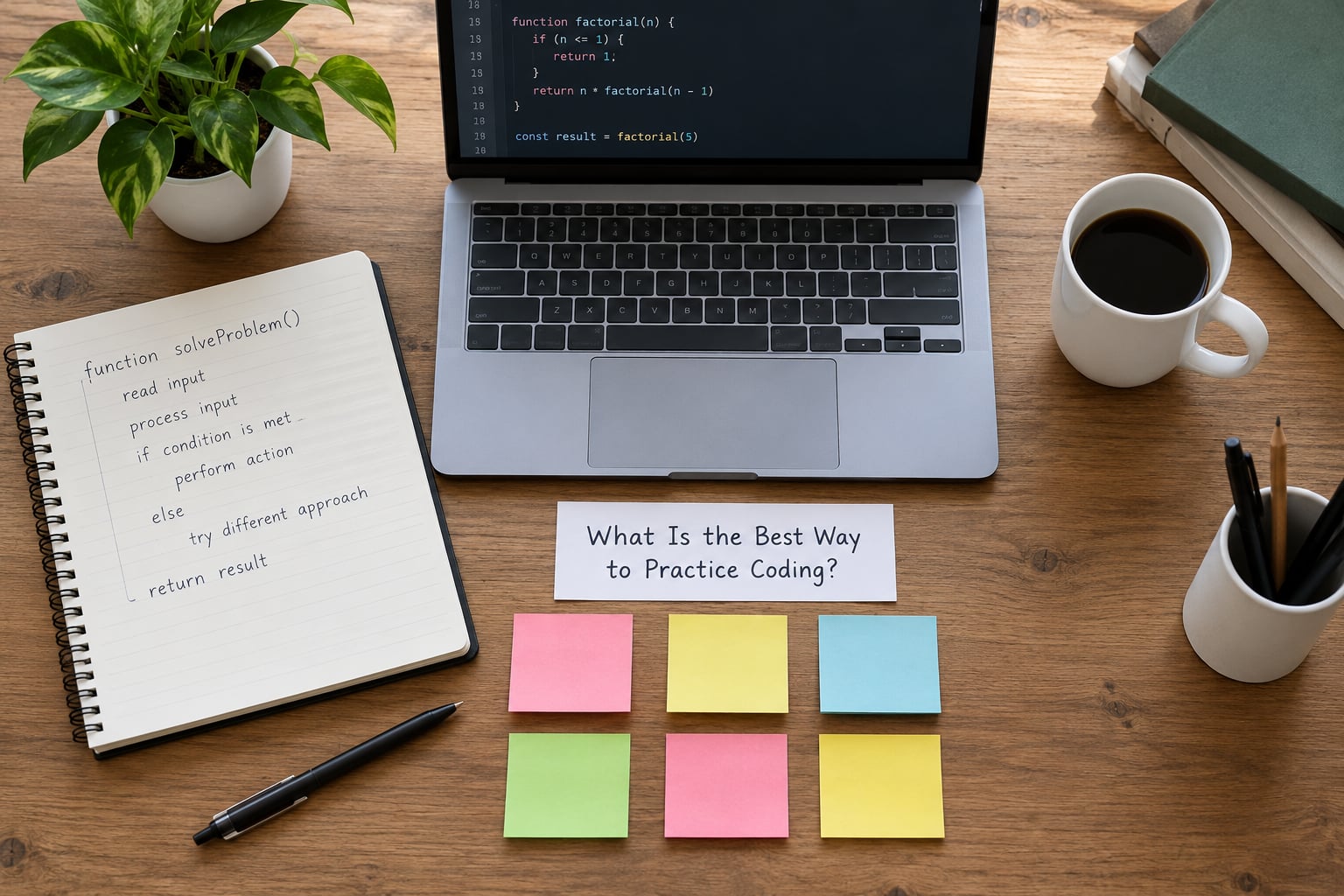
Practice is what turns knowledge into skill, and it looks different from watching lessons. Watching produces a feeling of progress. Writing code from a blank file produces the actual ability, and it feels much worse while it happens.
Small exercises, daily
Thirty to sixty minutes a day beats four hours on Sunday. Spaced repetition works because forgetting is fast and the cost of rebuilding a forgotten concept is high. Do one exercise, then move on.
Type from memory, not by copying
Close the tutorial and rebuild the example. Copy and paste teaches you nothing about recall. The gap between the two is exactly what you are trying to close.
Use a challenge site for the boring reps
Exercism runs small mentored exercises in dozens of languages. HackerRank and Codewars cover algorithm and string practice. LeetCode is worth it later, once loops and data structures are automatic; starting there is a well-documented way to feel stupid for two months.
Keep a project log
A plain text file or Markdown document where you record what you built, what broke, and what fixed it. Ten minutes after each session. This becomes raw material for your portfolio, your interview answers, and the blog posts that prove you can explain your work.
Get feedback from somewhere
Working alone with no reviewer is the most commonly reported gap on self-taught paths. Post code in a review community, join a study group, or pair on a small open source issue. Code review feedback arrives faster than you can manufacture it yourself.
A ten-hour week that works
- Five weekdays, one hour each: one new concept, then exercises on it.
- Two evenings, two hours each: build something small that uses this week’s concept.
- One weekend block, two hours: fix bugs, clean up commits, update the log.
How Do You Build a Portfolio Without a Degree?
Three to five substantial projects beat fifteen tutorial clones. A tutorial project is one where the person reading it can spot the course you followed within thirty seconds. Substance comes from the parts the tutorial skipped.
Choose projects with real constraints
A habit tracker with no accounts, no sync and no deploy is a tutorial project. Add authentication, a database, deployment and error handling and you have a real one, because now there are problems to solve that nobody handed you.
Document the decisions, not just the code
Each README should say what the project does, who it is for, the stack you chose, one or two technical decisions and the tradeoff behind each, the bugs you hit and how you resolved them, and what you would do differently. That reasoning section is what interviewers ask about, and it is exactly what a candidate with no degree tends to omit.
Publish it where recruiters look
Every project on GitHub with a working build, a README and a live demo link. Add a short profile README at the top of your account so a recruiter landing there sees who you are and what you have built.
Contribute to open source once
Fix a typo in documentation or resolve a small bug in a beginner-labelled repo. That pull request is your first evidence of working inside someone else’s codebase, which is a different skill from building your own.
Write resume bullets that survive a filter
Do not write “learned JavaScript”. Write “Built a task scheduler web app in JavaScript and Node with PostgreSQL persistence and deployed it on a cloud host, handling recurring jobs for 40 test users.” Name the stack, the scale and the result. If an automated filter looks for a degree and finds none, your bullet points are the only thing it has to read.
Do You Need a Computer Science Degree to Get a Coding Job?
It depends on the employer and the role, and the honest answer is that the market splits into three camps. Large companies with formal hiring processes often list a degree as a requirement or an equivalent. Agencies and smaller companies care about what you can demonstrate. And contractors or clients buying your time care only whether the work gets finished.
| Route | Typical structure | Main advantage | Main limitation |
|---|---|---|---|
| CS degree | 3-4 years, full time | Credential plus access to internships and campus recruiting | Slow, expensive, and the curriculum moves slowly |
| Coding bootcamp | 3-6 months, full time, cohort-based | Structure, deadlines, code review, career support | Costs money, and the marketing pages rarely answer honestly |
| Self-taught | Whatever you schedule, usually 1-2 years alongside work | Free or cheap, and you learn on real hardware you already own | No credential, no network, and no one forcing you to finish |
The clearest difference is accountability. A degree or a bootcamp supplies deadlines, other people who see your code, and access to people who already work in the field. A self-taught path has to manufacture all three, which is why it stalls so often.
If you need the structure, borrow it rather than buying it. Pick one curriculum, set a fixed weekly hour count, and put your work in front of another human at least monthly.
Where a degree still matters: large-company campus pipelines, security and defence work, and roles that require accredited credentials. Big data and machine learning interviews lean heavily on mathematics, which you can study independently but which the degree makes easier. Government contractor work often has formal education requirements written into the contract.
How Long Does It Take to Learn Coding Without a Degree?
Milestones beat timelines here, because the honest answer depends entirely on hours per week. Someone studying 20 hours a week and someone studying 6 are doing the same course at very different speeds, and both are progressing normally.
| Goal | Hours per week | Roughly | What marks it done |
|---|---|---|---|
| Comfortable writing scripts for your own work | 5-10 | 3-6 months | You automate a task you used to do by hand |
| Capable of building small projects end to end | 10-15 | 8-12 months | Three finished projects, one deployed |
| Applying to junior developer roles | 15-20 | 12-18 months | Portfolio live, Git clean, comfortable debugging live |
| Data analysis or analytics pivot | 10-15 | 6-12 months | SQL plus one analysis stack, and a portfolio of reports |
The part nobody warns you about is the plateau around month two or three. You can read code but you cannot predict what it will do, and nothing sticks. That phase is normal and it is where most people quit. It ends when the basics stop feeling like new material.
Weekly hours matter more than talent or age. Ten hours a week sustained for a year is roughly 500 hours of deliberate practice, which is far more practice than most degree graduates get on the fundamentals that interviews test.
What Should You Do First?
Here is a 30-day plan you can start tonight. It assumes about an hour a day on weekdays and a longer weekend block.
Days 1-3: choose a language and set up
Install a code editor, install the language runtime, and run a hello-world program. Then write something slightly harder from memory. Confirm your setup works end to end before anything else, because an untested environment is the most common reason beginners quit in week one.
Days 4-7: fundamentals and a log
Variables, conditionals, loops, functions. One hour of concept, one hour of exercises. Write down what you learned each day in a log you will keep for the whole year.
Week 2: data and files
Lists, dictionaries, reading a file, writing a file, parsing JSON. Build a script that does something you personally care about, even if it is only renaming files by date.
Week 3: version control and the command line
Initialise a Git repository for the project you just built. Make a commit every time it works. Practise navigating and running things from the terminal rather than clicking through a file manager.
Week 4: get one piece of feedback
Post your project somewhere with humans in it and ask for review. Then write a README covering purpose, stack, one technical decision with its tradeoff, and what broke. If you want, this is where using an AI assistant as a pair programmer pays off: ask it to review your code and explain the suggestions rather than writing the code for you.
Frequently Asked Questions
Can I become a software developer without a computer science degree?
Yes. Most hiring managers cannot tell from a repository whether someone learned at university or taught themselves. What they look for is working code, a portfolio with real projects, and the ability to explain your technical choices. Degree requirements do exist at some large companies and government contractors, so target your search accordingly. Everywhere else, a portfolio plus interview skill does the work.
How long does it take to learn to code with no experience?
At 10 hours a week, plan on three to six months to automate small tasks at work, eight to twelve months to finish small projects end to end, and 12 to 18 months before applying to junior developer roles. At 20 hours a week those numbers roughly halve. The usual trap is expecting a job in three months, which mostly produces burnout rather than a portfolio.
Is 25 (or 35) too old to start coding?
No. Age anxiety shows up constantly on beginner forums and it is not supported by anything real. People switch into development in their thirties and forties from teaching, accounting, trades and other fields. What actually limits you is weekly hours and whether you keep shipping projects. A career-change candidate with domain expertise often interviews better than a twenty-year-old with only side projects.
Do I need to know math to become a programmer?
Not for most roles. General web and back-end development needs arithmetic you already have: percentages, basic algebra and enough logic to reason through conditions. Data science, machine learning and game graphics lean on real mathematics, including linear algebra, statistics and calculus. If that work is your goal, budget extra study months for it, because no amount of coding practice substitutes.
Is a coding bootcamp worth it compared with teaching yourself?
The trade is structure for money. A bootcamp gives you deadlines, code review, a cohort and career support, which are exactly the four things self-taught learners report missing. Self-teaching costs far less and moves at your own pace, but you have to build the accountability yourself or you will stall. A reasonable middle path is free curriculum first, then structured help only once you know what you cannot learn alone.
Do AI coding assistants help beginners or ruin their fundamentals?
They help most when used to review and explain, not to generate. Ask for a critique of your code, an explanation of an error message, or a hint rather than a finished solution. If you paste in code you do not understand, you ship something you cannot debug later, and debugging is the skill being tested in interviews. Use it as a pair programmer who explains, not an autopilot.
Conclusion
The degree was never the thing that taught most developers to code. Shipping projects was, and you can do that without one. Pick a single language, follow one structured curriculum, keep a written log, get your work reviewed by other people, and put three real projects in a public repository where a recruiter can see them.
Start tonight. Install an editor, pick Python or JavaScript, and write something that prints a line of text in the first hour. Everything else follows from that one session.