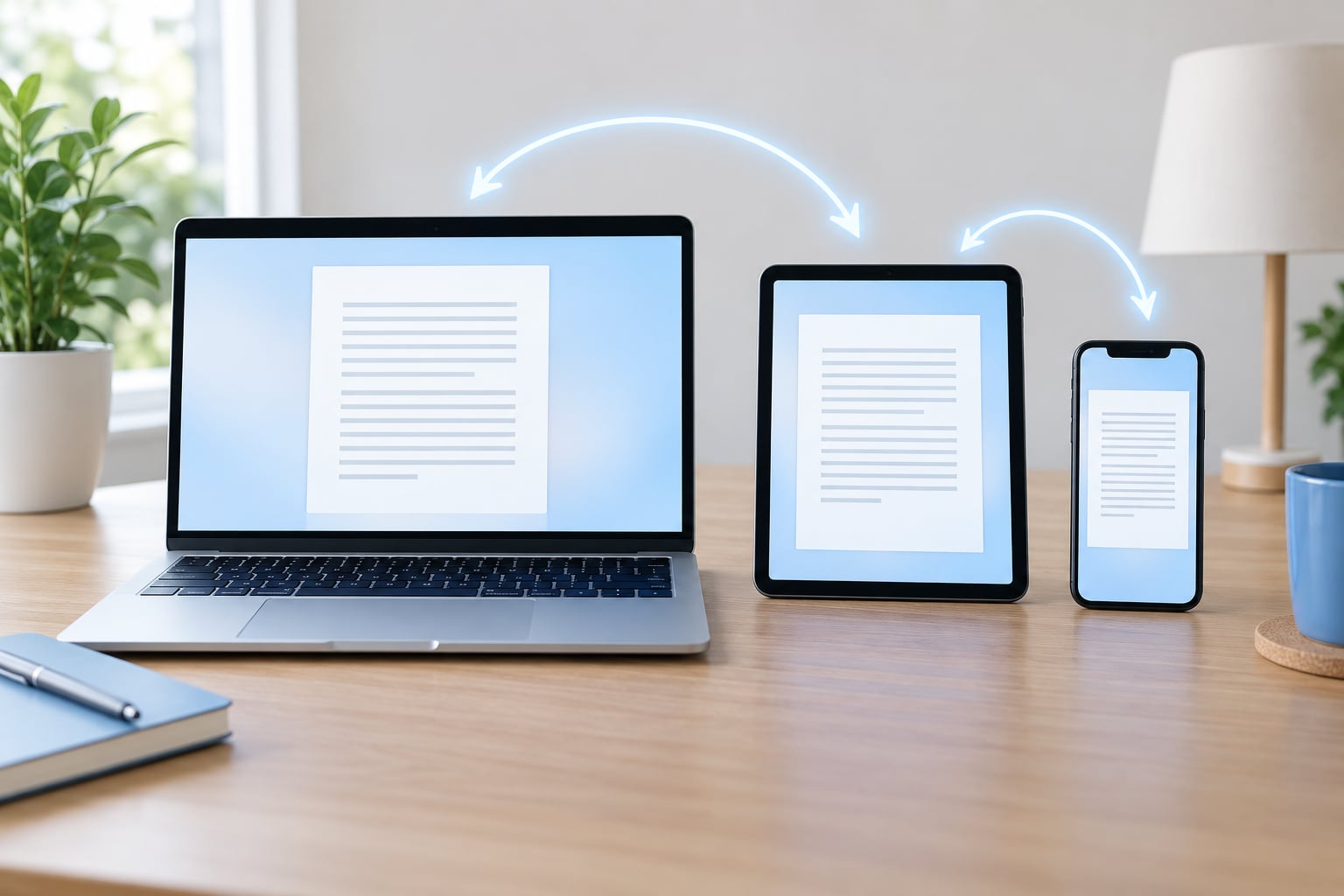
Syncing notes means every note you save is stored on a service’s server and pushed automatically to each device signed into the same account, so an edit on your phone shows up on your laptop within seconds. Getting it right comes down to three things: the same account on every device, sync switched on for that app, and a working internet connection. The whole setup takes about ten minutes per app.
The awkward part is that each platform wants a slightly different answer, and Apple Notes will not sync to Android at all. Below are the exact menu paths for Apple, Google and Microsoft, plus the cross-platform apps worth knowing if you move between ecosystems.
Table of Contents
- 1What You Need
- 2Step-by-Step: How to Sync Notes Across All Your Devices
- 3Choose the Right Notes Service for Syncing Notes Across Devices
- 4Set Up Apple Notes on iPhone, iPad, and Mac
- 5Set Up Google Keep on Android, iPhone, and the Web
- 6Set Up OneNote for Windows, Mac, iPhone, and iPad
- 7Use a Cross-Platform App for Mixed Devices
- 8Migrate Existing Notes Without Losing Content
- 9Common Mistakes
- 10Frequently Asked Questions
- 11Can I sync notes between an iPhone and an Android phone?
- 12Why are my Apple Notes not syncing to all of my devices?
- 13Can I use my notes without an internet connection?
- 14How do I move notes from Evernote or another notes app?
- 15Will notes and attachments use more storage when synced?
- 16What should I do if I am changing phones or switching ecosystems?
- 17What to Do First
What You Need
Three conditions have to be true before any notes service will sync anything. Every device must be signed into the same account. The sync toggle for that specific app must be on in each device’s settings. And each device needs an internet connection at some point so it can push and pull changes.
On the account side, you need whichever of these applies to your situation:
- Apple Account for Apple Notes and iCloud. Apple renamed Apple ID to Apple Account a few years back, and the two terms mean the same thing.
- Google account for Google Keep, available on Android, iPhone, iPad and the web.
- Microsoft account for OneNote, which is the only option that handles a Windows laptop plus an iPhone without a third-party app.
- An account with a third-party service for Joplin or Simplenote. Joplin can sync to Joplin Cloud, Dropbox, OneDrive, a WebDAV endpoint or a server you host yourself.
Give yourself a little storage headroom too. Apple Notes ride inside your iCloud allowance, and that free tier is shared with Mail, Photos and device backups. If iCloud storage is full, new notes stop uploading without any error message, and that is the single most confusing failure mode people hit.
Last thing: pick one primary notes system before you start. Running Apple Notes, Keep and Evernote side by side sounds tidy until you cannot remember which app held a given note. Choose one, get it syncing everywhere, and export a copy before you retire the old one.
Step-by-Step: How to Sync Notes Across All Your Devices
Choose the Right Notes Service for Syncing Notes Across Devices
Apple Notes is the smoothest option if you stay inside Apple’s ecosystem and it has no real cross-platform story. Google Keep, OneNote, Simplenote and Joplin all run on both iOS and Android. Here is how they differ.
| Notes service | How it syncs | Devices | Offline access | Best for |
|---|---|---|---|---|
| Apple Notes | iCloud | iPhone, iPad, Mac, iCloud.com | Full, edits queue until online | All-Apple setups, handwriting and scans |
| Google Keep | Google account | Android, iPhone, iPad, web, desktop | Full | Quick capture, lists, sharing with family |
| Microsoft OneNote | Microsoft account or iCloud | Windows, Mac, iPhone, iPad, web | Full | Windows plus iPhone mixes, meeting notes |
| Simplenote | Simplenote account | Every major platform and the web | Full | Plain text, zero fuss, free forever |
| Joplin | Joplin Cloud, Dropbox, OneDrive, WebDAV, self-hosted | Every major platform and the web | Full | Markdown, attachments, self-hosting |
| Evernote | Evernote account | Every major platform | Full | Web clipping and PDF annotation; free tier limits note count |
One warning before you choose: a note you lock with a passcode in Apple Notes is encrypted on that device and will not appear on your other devices. Locking and cross-device sync cannot both be your default.
Set Up Apple Notes on iPhone, iPad, and Mac
On iPhone and iPad running iOS 17 or later, open Settings, tap your name at the top, then iCloud, then Notes. Turn on Sync this iPhone. On iPad the same toggle is worded Sync this iPad.
On Mac, open System Settings, click your name in the sidebar, choose iCloud, then Notes and turn on Sync this Mac. Older macOS releases put iCloud under Apple menu, System Preferences.
Confirm both devices use the same Apple Account. If you signed up with an old .me address or a different Apple ID on the Mac, the notes never meet, and there is no error to tell you so.
Now look for a folder called On My iPhone or On My Mac in the folder list. Notes there were created before sync existed or while iCloud was switched off, so they live only on that device. Tap one to open it, select all, and drag the notes into an iCloud folder.
Verify the sync landed by opening iCloud.com/notes in any browser and signing in. If your test note shows up in the web version, it reached the server, and every other device signed into that account will get it too.
Set Up Google Keep on Android, iPhone, and the Web
Install Google Keep from the Play Store or the App Store, then sign in with the Google account you want to own the notes. That sign-in is the entire sync mechanism, so use the same account on every device.
On Android, the app can get stuck behind a system-level switch. Open Settings, tap Accounts, select your Google account, tap Account sync, and confirm Google Keep is toggled on. Nothing appears in the Keep app’s own settings about this, which is why it catches people.
Check your work at keep.google.com in any browser. Create a test note on the phone titled something you’ll remember, refresh the browser tab, and confirm it appears. If it shows in the browser but not on a second device, the problem is that device’s account or its sync switch.
Set Up OneNote for Windows, Mac, iPhone, and iPad
On Windows, install OneNote from the Microsoft Store and sign in with your Microsoft account, the same one tied to Microsoft 365 if you have it. On Mac and on iPhone and iPad, install OneNote, sign in, and the notebooks attached to that account appear.
The Mac is the confusing part because two different apps share the name. The Microsoft OneNote app for Mac syncs through your Microsoft account and also handles Apple Notes and iCloud Drive notebooks if you switch that on in the app. The older Mac version was a separate, thinner app. Whichever you use, confirm which account is shown in the account menu before you trust the sync.
Notebook selection matters too. Notebooks that live only on your Mac’s hard drive, and notebooks created inside a third-party OneDrive or SharePoint workspace tied to a work account, will not follow you to a personal phone. Open the notebook picker and check which notebook holds your notes.
To verify, add a note on the phone, then check onenote.com in a browser signed into the same Microsoft account.
Use a Cross-Platform App for Mixed Devices
If your household or workflow mixes an iPhone with an Android phone, or you want your notes somewhere you control, Joplin is the most capable of the free options. Install it on every device, then set the sync target once and repeat that choice on each machine.
Open Settings, then Sync, in Joplin. Pick Joplin Cloud for the fastest route, or choose Dropbox, OneDrive or WebDAV if you already keep files in one of those. Advanced options let you point at a self-hosted WebDAV endpoint such as Nextcloud, which keeps the notes on a server you administer.
Joplin Cloud is a paid subscription while the app itself stays free, and the alternative storage targets have no such fee. Whichever you pick, create one test note on device one, open the app on device two within a minute, and confirm it arrived. After that, sync runs in the background every time the app opens.
Simplenote is the low-friction alternative: create an account, sign in, and notes sync across every platform including the web. It handles plain text and tags, not attachments, which is the trade-off.
Migrate Existing Notes Without Losing Content
Moving a library is the step people rush, and it is where attachments go missing. Export from the old app first, always, and keep that export until you have checked the new library note by note.
Apple Notes has no one-click export. Open a note, tap Share, choose Print, pinch out on the preview to make a PDF, then save or share that PDF somewhere. For a bulk move, select notes and drag them out of iCloud into a folder in Mail or Files, or forward them to yourself as emails, then paste the content into your new app.
Google Keep exports to Keep, then Export notes, producing a ZIP of text and attachments. OneNote exports a notebook through File, Export as a .one package. Evernote exports notebooks as .enex files, which several apps including Joplin and Obsidian can import.
Import in small batches. Do one folder, open three or four notes on a second device, check that images and tables came through, then continue. A clean import of forty notes tells you far more than a hopeful glance at one.
Common Mistakes
When sync stalls, work down this list from cheapest fix to most disruptive. The order matters, because the fixes at the bottom can cost you notes if you run them without a backup.
| Symptom | Likely cause | Fix |
|---|---|---|
| Notes sync to one device but not another | Different account signed in on that device | Compare the account shown in each app’s settings; sign into the same one |
| Old notes never appear elsewhere | They sit in On My iPhone, On My Mac, or a local notebook | Select all notes in the local folder and drag them into the cloud folder |
| Nothing syncs after an upgrade or a new phone | Sync toggle off, or an old backup restored a pre-sync state | Re-check the sync toggle, then sign out and back in to the app account |
| Sync fails on hotel or campus Wi-Fi | Captive portal or VPN filtering the connection | Turn the VPN off, forget the network, reconnect through phone tethering to test |
| New notes stop uploading, no error shown | Cloud storage full | Check storage usage for iCloud or Google; delete large attachments or photos |
| Sync stalls for everyone at once | Service outage | Check the vendor system status page before changing anything |
| Duplicate notes and merged text | The same note edited offline on two devices | Open each duplicate, keep the complete version, delete the copy |
| A locked note is missing on the laptop | Passcode-encrypted notes stay on the device that created them | Unlock and re-save the note on the device, or keep locked notes off your sync-critical library |
| A shared note never updates for a collaborator | They are offline, or the note sits in their Shared with me folder | Have them open the app while online and check that folder for your copy |
One trick comes up in nearly every troubleshooting thread: create a throwaway note, then delete it. That nudges the sync engine into re-fetching, and it costs nothing. Check the web version of the app afterward, since that is the fastest way to tell whether a note reached the server or never left the phone in the first place.
Now the steps I would not run casually. Toggling iCloud Notes off and on again can clear local notes on a device that never uploaded them. Deleting an account from a device removes the notes from that device too, and deleting the account at the service end removes them everywhere. Resetting network settings is harmless but will not fix an account mismatch, so it is wasted effort if you skipped the earlier checks.
Before any of those, export your notes or take a screenshot of the folder structure. It takes five minutes and removes the only real risk in this whole process.
For keeping things healthy afterwards: leave the app’s background refresh on, restart a device whenever sync goes quiet for a day, and export a copy every few months to a folder outside the notes app. Sync is a convenience, not a backup. A separate copy is a backup.
Frequently Asked Questions
Can I sync notes between an iPhone and an Android phone?
Not with Apple Notes. Apple Notes only reaches iPhone, iPad, Mac and iCloud.com, so an Android phone will never see them. For a mixed household, use Google Keep, Microsoft OneNote, Simplenote or Joplin, all of which run on both systems and sync through one account. Move your old notes out first, since nothing transfers itself.
Why are my Apple Notes not syncing to all of my devices?
Usually one of four things: a device is signed into a different Apple Account, Sync this iPhone or Sync this Mac is off, the notes are sitting in an On My iPhone folder instead of iCloud, or your iCloud storage is full. Sign into iCloud.com/notes in a browser and check whether the note appears there. If it does, the server is fine and the problem is on one specific device.
Can I use my notes without an internet connection?
Yes. Apple Notes, Google Keep, OneNote and Joplin all open and work offline. Reading is instant, and anything you type gets saved on the device and uploaded once you reconnect. The only catch is that a note you create offline will not appear on your other devices until the device rejoins the network, which is worth remembering before a flight.
How do I move notes from Evernote or another notes app?
Export first. Evernote gives you .enex files, Google Keep gives a ZIP of text and attachments, and OneNote exports a notebook package. Then import into the new app, or paste the content in note by note when no importer exists. Test a handful of notes with images on both devices before moving the whole library, and keep the export until you have checked.
Will notes and attachments use more storage when synced?
Yes, and images are where the space goes. Synced notes count against your cloud allowance, so thousands of photos and PDFs add up faster than text ever will. The free iCloud tier is small and shared with Mail and Photos, and a full allowance quietly stops new notes from uploading. Archive big attachments to Drive and keep links in the note.
What should I do if I am changing phones or switching ecosystems?
Sign into the new phone with the same account first and let the sync finish before wiping the old device, then confirm your notes in the web version. If you are switching brands, Apple Notes will not come with you, so export the library into Keep, OneNote or Joplin while you still have access to the old phone.
What to Do First
Start with one service and one account. Turn on its sync toggle on every device, then check the web version to confirm a test note actually reached the server. Once that works, pull any stragglers out of local folders, and export a backup you keep somewhere outside the app.