Picking a power bank comes down to one number, and most people get it wrong in the same way: they divide their phone’s battery size by the number printed on the bank and trust the result. That math gives a figure roughly 20% too generous. If you want to know how to choose the right power bank capacity, work through three inputs instead: your device’s battery size in mAh, how many top-ups you actually need away from a wall, and the conversion loss of about 80% that every power bank eats along the way. That lands most people on a 10,000mAh bank, with 5,000mAh for light use and 20,000mAh for travel, tablets, or laptops.
I keep two power banks and reach for the same two every time, and neither is the biggest one I own. That is the whole lesson of this guide. Capacity is one variable among several, and the oversized bank in a laptop bag is mostly dead weight you charge twice as often and hope never to need.
Table of Contents
- 1Power Bank Capacity: What Number Do You Need?
- 2How to Calculate the Capacity You Need
- 3How to Choose the Right Power Bank Capacity for Each Device
- 4Match Capacity to Charging Speed and Ports
- 5Capacity, Size, Weight, and Travel Tradeoffs
- 6Battery Safety Features to Look For
- 7A Quick Checklist Before You Buy
- 8Frequently Asked Questions
- 9Should I get a 10000mAh or 20000mAh power bank?
- 10What is the actual capacity of a 10000mAh power bank?
- 11Is a 20000mAh power bank overkill?
- 12Can I bring a 30000mAh power bank on a plane?
- 13How many times can I charge an iPhone with a 10000mAh power bank?
- 14What is mAh in a power bank?
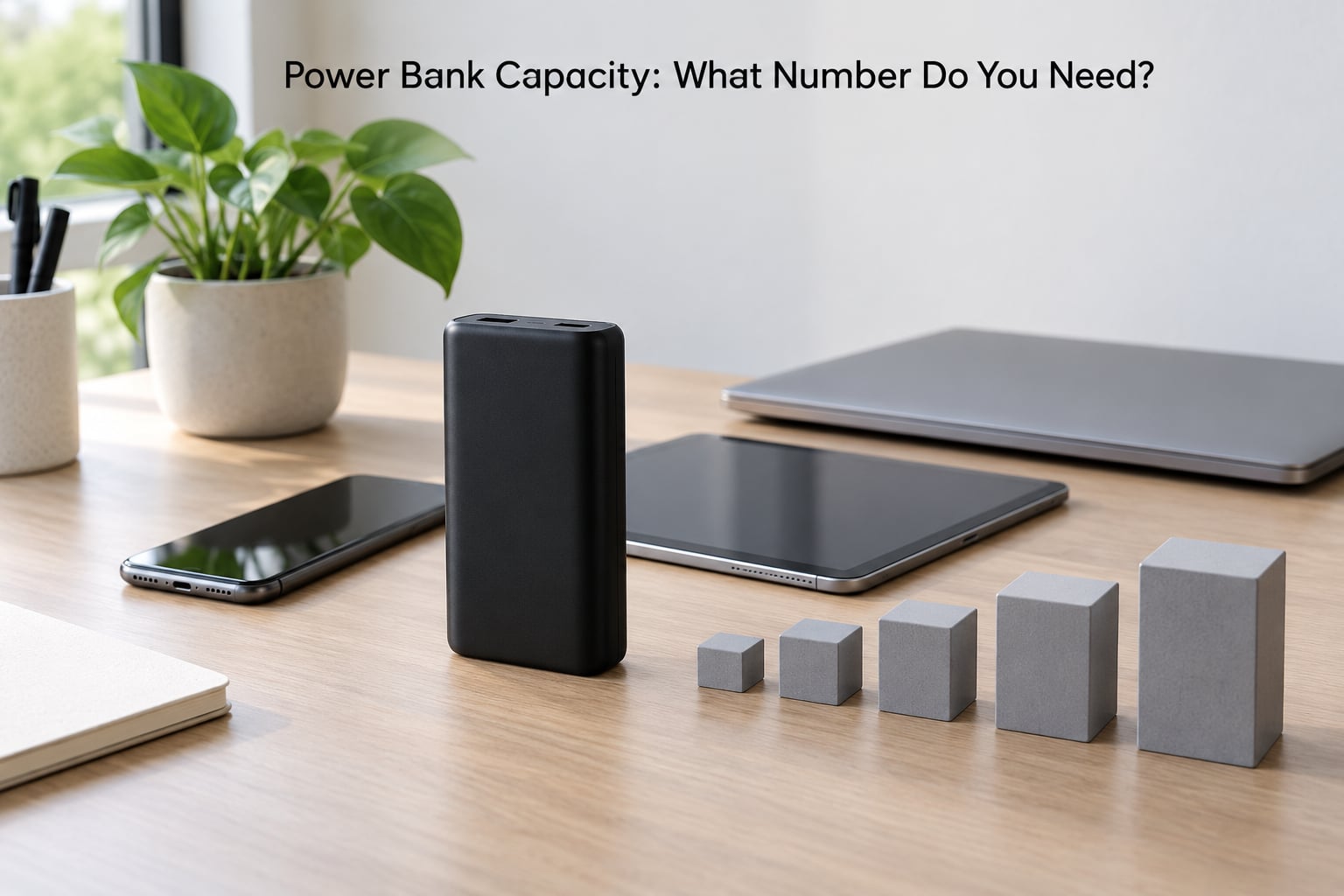
Power Bank Capacity: What Number Do You Need?
mAh stands for milliamp-hours, and it measures how much charge a battery holds. Watt-hours, or Wh, measure how much energy. A phone battery rated at 4,000mAh sits at a nominal 3.7 volts, which works out to about 14.8Wh of actual stored energy.
Power banks are printed in mAh, laptops and airline rules are printed in Wh, and converting between them is one multiplication: Wh = (mAh x 3.7) / 1000. A bank labelled 10,000mAh holds roughly 37Wh. A bank labelled 30,000mAh holds roughly 111Wh.
Two more terms matter. The labelled capacity is what the seller prints. The rated capacity is what the cells actually deliver, and it is always lower. Regulators require it to be printed too, usually in small text on the side of the casing.
| Tier | Label mAh | Energy | Usable at 80% | Top-ups for a 4,000mAh phone | Rough weight | Cabin baggage |
|---|---|---|---|---|---|---|
| 5,000mAh | 18.5Wh | ~4,000mAh | 1 | 110 to 180g | Allowed | |
| Everyday | 10,000mAh | 37Wh | ~8,000mAh | 2 | 180 to 360g | Allowed |
| Travel | 20,000mAh | 74Wh | ~16,000mAh | 4 | 350 to 500g | Allowed |
| Camping | 30,000mAh | 111Wh | ~24,000mAh | 6 | 550 to 700g | Needs approval |
| Power station | 50,000mAh and up | 185Wh and up | ~40,000mAh | 10 or more | 1kg and up | Needs approval |
Those weight figures are typical ranges for mainstream banks, not exact figures for any one model. The pattern is what matters: every 10,000mAh of capacity adds roughly 150 to 200g, and that weight is the real price tag on a bigger number.
How to Calculate the Capacity You Need
Four steps, and you will have a number you can defend instead of a guess.
Step 1: Find your device’s battery capacity in mAh. It is in the technical specifications on the manufacturer’s site, or under Battery in your phone’s settings. Most current phones fall between 4,000 and 5,000mAh. If you cannot find the figure, 4,000mAh is a fair working assumption.
Step 2: Decide how many top-ups you need away from a wall. Not how many days. One top-up per day for a long trip is generous because you sleep, you are near a car, and a coffee shop outlet counts. A phone topping up from 20% to 80% only consumes about 60% of its battery, so it needs 2,400mAh rather than 4,000mAh.
Step 3: Apply the efficiency factor. Divide by 0.8, because the conversion from the bank’s 3.7V cells up to the 5V or 9V your phone expects loses heat and energy. Budget-built banks sit closer to 85%, good ones reach 90%.
Step 4: Round up to the next real tier. Nobody sells a 14,000mAh bank. You buy 20,000mAh or you accept 10,000mAh and live with it.
Here is the arithmetic on a 10,000mAh bank and a 4,000mAh phone. Usable capacity is 10,000 x 0.8 = 8,000mAh. Charges available is 8,000 / 4,000 = 2. Now factor in that nobody runs a phone flat to zero, and you have a first full charge plus a solid part-charge, which in practice covers two days away from an outlet.
Push the same example to 20,000mAh and you get 16,000mAh usable, which is four full phone charges or roughly a week of heavy use. For a two-week trip with no reliable power, that is the honest number.
How to Choose the Right Power Bank Capacity for Each Device
Devices differ far more than the marketing suggests. Earbuds and watches draw almost nothing, while a laptop draws more than a phone by an order of magnitude.
| Device | Battery size | What it needs |
|---|---|---|
| Wireless earbuds | 300 to 600mAh each case | A 5,000mAh bank covers days of use |
| Smartwatch | 300 to 500mAh | 5,000mAh is plenty, unless charging is magnetic-only |
| Compact phone | 2,000 to 2,500mAh | 5,000mAh gives one emergency top-up |
| Current phone | 4,000 to 5,000mAh | 10,000mAh gives two solid days |
| E-reader | 1,000 to 2,000mAh | 5,000mAh covers a week easily |
| Small tablet | 3,000 to 5,000mAh | 10,000mAh gives a full day of heavy reading |
| Tablet around 10 inches | 10,000 to 11,000mAh | 20,000mAh gives one and a half full charges |
| Thin laptop | 40 to 60Wh | 20,000mAh gives roughly one partial charge, and needs 60W output |
| Full-size laptop | 60 to 100Wh | A power bank is the wrong tool. Look at a power station |
Emergency backup is a different goal from multi-day use. A 5,000mAh bank in a drawer is insurance against a dead phone at 9pm, and its job is to make one call or one QR scan work. If you are off-grid for four days, the same 5,000mAh is a rounding error.
The other half of the question is how many devices run at once. A phone plus a tablet plus earbuds over a long bus ride is a different target from a phone alone, and the r/powerbanks and r/travel threads are full of people who packed for one device and arrived with three.
Match Capacity to Charging Speed and Ports
A bigger case does not charge faster. Capacity is how much energy the pack holds; charging speed is how quickly it hands that energy over, and the two come from different circuits.
For a phone, what matters is output wattage. A 10,000mAh bank with 20W USB-C Power Delivery fills a modern phone in about an hour and a half. A 20,000mAh bank with 10W output takes nearly as long and then does it twice. Same device, same wait, one pack that is simply twice as big.
For a laptop, the watt requirement is the constraint that decides everything. A thin laptop typically draws 40W to 65W, and most 5,000mAh and 10,000mAh banks top out at 18W or 20W because their cells cannot deliver more. They will fill a laptop at the trickle rate the laptop refuses to draw from, or not at all. If a laptop is part of your plan, you need a 20,000mAh bank with 60W or 65W USB-C PD, and that is a short list.
Port count matters more when you carry multiple devices. Two USB-C ports and one USB-A means you can charge a phone and a tablet simultaneously, but the total output is shared, so both run slower. Manufacturers usually print the combined maximum, and that figure is worth reading before you assume you get two full-speed ports.
Pass-through charging, where the bank charges your phone while the bank itself is plugged in, is genuinely useful on a long flight. It is also the fastest way to run a bank flat, and some cheap models refuse to do it at all. Wireless and magnetic charging banks are rated much lower than their label suggests, usually 5W or 10W, because the coil wastes energy as heat. Treat a magnetic bank as a convenience top-up rather than a substitute for a cable.
Capacity, Size, Weight, and Travel Tradeoffs
Here is where the tradeoffs get real, and where the extra 10,000mAh stops being free.
| Label mAh | Energy in Wh | Flight position |
|---|---|---|
| 5,000mAh | 18.5Wh | Allowed with no paperwork |
| 10,000mAh | 37Wh | Allowed with no paperwork |
| 20,000mAh | 74Wh | Allowed with no paperwork |
| 27,000mAh | 100Wh | The hard ceiling |
| 30,000mAh | 111Wh | Above the ceiling, needs airline approval |
| 40,000mAh | 148Wh | Above the ceiling, needs airline approval |
| 50,000mAh | 185Wh | Beyond what most airlines will approve |
The rule across most of the world follows international guidance: up to 100Wh goes in your cabin bag with no approval, anything between 100Wh and 160Wh needs approval from the airline in advance, and you can carry a maximum of two spare batteries. Carriers publish their own wording and enforcement varies, so check yours before a long trip rather than assuming a 30,000mAh bank will pass.
Enforcement has tightened in recent years in a way that catches people out. Gate staff do check, and several carriers have quietly dropped the free power banks they used to hand out mid-flight. The current direction of travel is to keep the pack on your person rather than in the overhead bin, which removes the temptation to stash a spare one up there and forget about it.
There is a workaround worth knowing: two 20,000mAh banks stay under the ceiling individually and together give you 40,000mAh of capacity, which beats one oversized pack that needs approval paperwork. It also gives you a backup if one fails to turn on after a long trip.
Recharge time is the constraint nobody mentions. A 20,000mAh bank refilling over USB-C at 30W takes roughly three hours. At 10W it takes closer to ten, and many older banks sit in the ten-to-twelve-hour range. A 50,000mAh bank genuinely needs a wall socket to be useful, so beyond about 30,000mAh you are buying a small power station rather than a power bank. Those are fine for a car trunk or a week of camping, where weight does not matter and charging from a socket is rare.
Battery Safety Features to Look For
Capacity is the number you compare; safety is the reason you do not have a news story about your bag. Check for these before anything else.
Overcharge protection stops the bank being pushed past full. Over-discharge protection stops cells draining to nothing, which permanently damages them. Short-circuit protection handles a frayed cable or a foreign object in a port. Temperature management cuts output or shuts down if the cells get too hot, which is the protection that matters most in a car or a hot bag.
Look for a printed rated capacity alongside the label, and for certification marks such as UL, CE, or the relevant UN 38.3 transport testing that a legitimate cell manufacturer puts on the pack. A bank with no rated capacity printed anywhere and no identifiable brand is the one to walk away from, and the pattern is consistent: buyers who test cheap banks report delivered capacity far below the label, while the same buyers say they would buy the same brand again for reliability.
The arithmetic on why label and reality diverge is worth holding onto. A 10,000mAh cell at 3.7V is 37Wh. Your phone charges at 5V, so the bank has to push more current through a higher voltage and gives off the difference as heat. Buyers who test with a USB meter consistently land somewhere between 65% and 85% of the printed figure, and a bank sitting at the bottom of that range on a 10,000mAh label delivers closer to 6,500mAh.
A Quick Checklist Before You Buy
Run through this once and the purchase takes about a minute.
1. Write down your device battery capacities in mAh, including every device you plan to charge.
2. Multiply by the number of top-ups you actually need, using partial charges rather than full ones if you are disciplined about it.
3. Divide by 0.8 and round up to the next real tier.
4. Check the Wh rating printed on the casing and convert it against the airline limit if you are flying.
5. Match output wattage to your devices: 18W to 20W for phones, 45W to 65W for a laptop.
6. Count ports and confirm whether the shared output total still supports your devices at full speed.
7. Weigh it against how you will carry it. Anything past 500g needs a real reason.
8. Confirm the safety protections and the printed rated capacity are present.
If you already own a bank and want to check whether it tells the truth, you can test it in about ten minutes. Charge your bank fully, run it flat into a USB power meter while you discharge a phone, then read the meter’s accumulated watt-hours at the end and convert back to mAh by dividing by the phone’s charging voltage. Results landing between 65% and 85% of the label are normal. Results well under half mean you have a problem worth returning.
And the reverse check takes even less time. If the Wh rating is missing from the casing, treat it as information rather than an oversight.
Frequently Asked Questions
Should I get a 10000mAh or 20000mAh power bank?
Take 10,000mAh if you charge one phone and want two days away from a wall. It gives roughly 8,000mAh of usable charge after conversion losses, which is about two full phone charges. Take 20,000mAh if you carry a tablet, travel for more than a few days, or want not to think about it. The extra weight is the only real cost.
What is the actual capacity of a 10000mAh power bank?
Expect roughly 8,000mAh in honest terms. The label counts charge at the cells’ 3.7V, and raising that to the 5V or 9V your phone expects costs energy as heat, leaving about 80%. Good banks reach 85 to 90% of the label. Cheaper units often deliver closer to 65%, or around 6,500mAh.
Is a 20000mAh power bank overkill?
Only if you carry a phone and nothing else. A 20,000mAh bank gives roughly 16,000mAh usable, about four full charges of a 4,000mAh phone, and that is exactly right for a phone plus earbuds on a week-long trip. Carrying it for a single phone on a day out is where the extra 200 to 350g becomes dead weight.
Can I bring a 30000mAh power bank on a plane?
Not without prior approval. A 30,000mAh bank is about 111Wh, which sits above the 100Wh ceiling most airlines apply to cabin baggage. Batteries up to 100Wh travel without paperwork, those between 100Wh and 160Wh need approval from your airline in advance, and the limit is two spare batteries. Two 20,000mAh banks stay under the line each.
How many times can I charge an iPhone with a 10000mAh power bank?
About two. Take 8,000mAh of usable capacity and divide by your model’s battery size: a 3,280mAh iPhone gives roughly 2.4 charges, a 3,950mAh iPhone 16 gives roughly 2, and a 4,700mAh iPhone 16 Pro Max gives about 1.7. In practice you rarely run a phone to zero, so two comfortable top-ups is a fair expectation.
What is mAh in a power bank?
mAh is milliamp-hours, a unit of charge, and it is how most power banks are labelled. Because charge alone does not tell you energy, watt-hours, or Wh, are the fairer comparison: multiply mAh by the cell’s 3.7V nominal voltage and divide by 1,000. A 10,000mAh bank holds about 37Wh, which is the number airlines care about.
The rule that settles it: buy the smallest tier that covers your devices for your longest trip without a wall, then stop. For one phone, that is 5,000mAh to 10,000mAh. For a phone and a tablet over a long journey, 20,000mAh. Past 30,000mAh you are carrying a power station, and above 100Wh you are asking an airline for permission. Recheck this sizing method in 2026 when your main device changes, since battery sizes have grown every few years and your target moves with them.